Help me choose
When a Ready-Made Design Beats a Custom One
A ready-made design is not a fallback. In several real situations it is the stronger choice on its own merits, not just the faster one.
By Influxer · Published 2026-08-16 · Updated 2026-08-16 · 5 min read
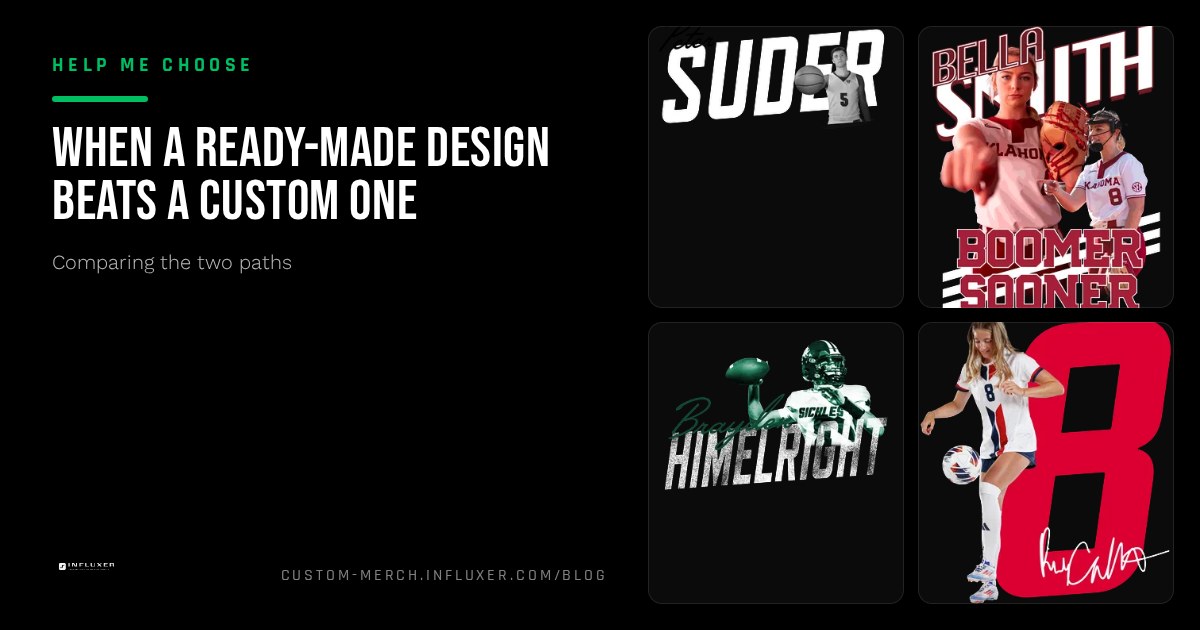
Ready-made designs—often called templates—frequently get treated as the consolation prize for people who don't have their own artwork. This perspective sells them short. In reality, there are many situations where starting from a ready-made layout is the objectively stronger choice on its own merits, completely independent of whether you happen to have a logo sitting around.
This is not an argument that templates beat custom work in every single scenario. Instead, it is a focused list of specific conditions where the trade-offs actually favor starting from a tested, professional layout. By recognizing your own situation in these examples, you can make a choice that results in better merch and a smoother path to taking live your new drop.
Whether you are ordering for yourself or your whole team, understanding the structural advantages of a ready-made design helps you avoid common print pitfalls. Let's look at why a "pre-built" path might actually be your best move.
From readability to color contrast, ready-made designs have already solved the problems that often trip up custom artwork. Here is when you should lean into that expertise.
When the design needs to work for a group, not just one person
A ready-made layout in the Influxer studio has already been rigorously checked for readability at chest-print scale on real garments. When you are ordering for a team, a family, or a group of buyers with wildly different tastes, a layout proven to read clearly across different body types and shirt sizes is a much safer bet.
Highly personalized custom designs often rely on specific aesthetics that only one person is fully sold on. A ready-made design, by contrast, uses balanced typography and spacing that has a broader appeal, making it more likely that everyone in the group will actually wear the shirt rather than just keeping it in a drawer.
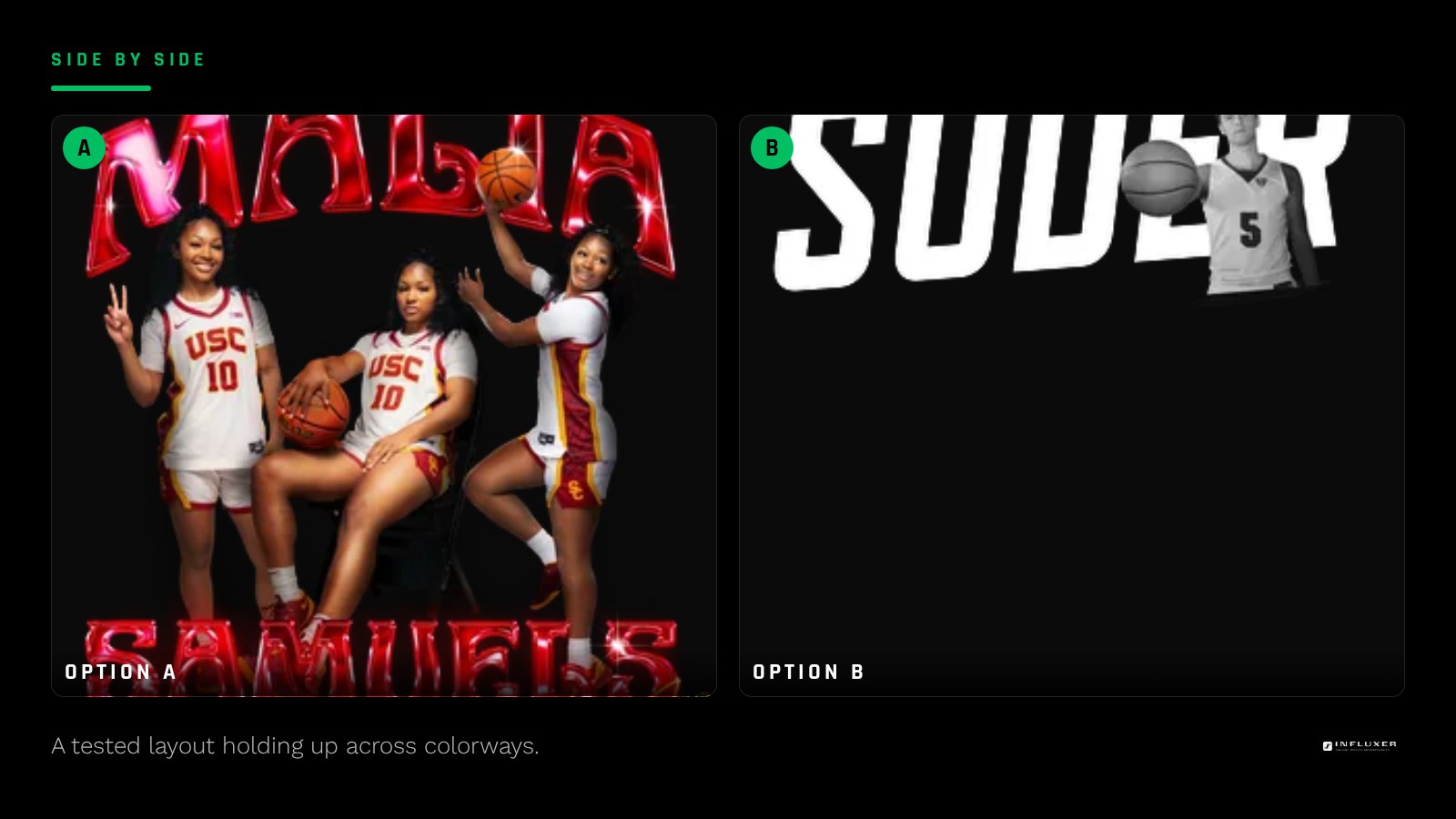
When you want several colorways to look intentional
Ready-made layouts are built with multiple garment colors in mind from the start. A design that looks sharp on an Ivory tee is already optimized to hold up on a Pepper hoodie or a Blue Spruce long sleeve without needing manual adjustments to the colors or strokes.
If your own custom artwork was built with a single background in mind (like a white background on your laptop screen), spreading it across several garment colorways can expose contrast problems you won't catch until you see the mockup. Templates have effectively been "pre-tested" across the entire Influxer palette.
- Team drops with several colorways benefit from tested contrast across dark and light garments.
- A design intended for only one shirt color doesn't need this specific advantage as much.
- Consistent look: templates maintain the same visual weight across different shirt styles.
When your sport has strong visual conventions
Sports like football, wrestling, and track have powerful visual shorthand that fans recognize instantly: bold numerals, angular typography, and specific icon styles. Ready-made layouts built for a given sport already lean into that shorthand.
By using a template, you get a design that reads as "professional football merch" at a glance without having to invent that visual language yourself. You get to stand on the shoulders of existing design trends that are already proven to sell.
This is especially useful for niche sports where a generic "sports" design might feel out of place. A dedicated volleyball layout, for example, will use elements that a general design simply won't include.
When you do not have time to iterate on files
Custom artwork, even high-quality artwork, often needs a round of technical adjustments once you see it on the actual garment mockup: the placement might feel slightly off, the scaling might be too aggressive, or a specific color might clash with the fabric. A ready-made layout has effectively already been through that iteration round.
When you use a template, you are far less likely to hit a surprise late in the process. If you have a tight deadline to take live your store, removing that iteration step can be the difference between hitting your date and missing it.
When you are not confident judging your own design choices
This is a common and perfectly reasonable situation: you can tell when something looks "off," but you aren't confident building something from scratch that looks "right." A ready-made layout removes that stressful judgment call entirely.
Instead of evaluating your own creative work in isolation, you are choosing between finished, professional options. You can focus on picking the name, number, and colors you like, knowing that the structural design work has already been handled by experts.
The "Middle Path": A hybrid approach
If a ready-made layout fits your situation but you also have a personal mark you want represented, remember the hybrid move. You can place your own logo into a proven layout. This captures both advantages: a tested, professional composition and your own unique identity.
This hybrid path is often the best of both worlds for athletes who are building a serious brand but want the reliability of a template for their core apparel line.
A worked example of the trade-off
Imagine a volleyball team ordering hoodies for twelve players. Each player has a different preference for what "looks good." A ready-made volleyball layout in the studio already accounts for how a bold number and team name read on the SS4500 hoodie chest area, in three different colors. This removes twelve separate opinions from the equation and ensures a cohesive look.
Now, compare that to an athlete ordering a single tee for themselves with a wordmark they designed and already love. There is no group to satisfy and no colorway spread to test, so the advantages of a ready-made layout matter far less. In this case, their own artwork is clearly the winner.
The key is to ask: who is this for, and how much technical risk am I willing to take? If the answer is "a group" or "low risk," the template wins.
Signs a ready-made design is your stronger pick
- You are ordering for a group or team with mixed tastes.
- You want to offer multiple garment colors without testing each one.
- Your sport has distinct visual styles that you want to leverage.
- You have a tight deadline and no time for multiple revision rounds.
- You prefer choosing between finished options rather than building from scratch.
- You don't already have a high-resolution personal logo or mark.
- You want the peace of mind that comes with a pre-tested layout.
Frequently asked questions
Does choosing a ready-made design mean my merch will look generic?
No. Because you can customize the name, number, and color combinations—and even add your own logo—you can create a look that feels unique to you while still using a professionally balanced layout.
Can I see the template on different garments before I decide?
Yes, the Influxer studio lets you toggle between tees, hoodies, and other garments in real-time, showing you exactly how the layout adapts to each physical product.
What if none of the available layouts fit my specific sport?
That is a clear signal to lean toward uploading your own custom artwork. A template only provides an advantage when it is genuinely close to what you need; don't force a fit that isn't there.
Is it faster to take live a store using a template?
Generally, yes. Since the design is already print-ready, it often moves through the technical review process faster than custom files that might need resolution or transparency fixes.
Start your merch — See whether a ready-made layout fits your situation.
Browse ready-made designs — Look through layouts already tested on real garments.